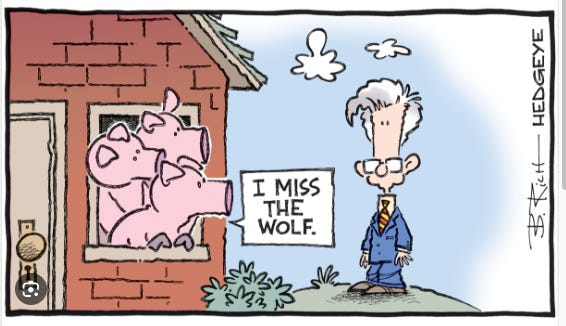
Super Heroes & Sequels - The FED & Déjà Vu Crises
Subprime’s CRE Sequel 15 Years In The Making

As you sit back and watch the opening credits of the latest crisis unfold, it's hard not to feel a mix of déjà vu and anticipation. What twists will this season bring? Which characters will rise to the occasion, and which will fall into the same old traps? And, more importantly, will the writers—ahem, policymakers and regulators—finally give us a satisfying conclusion, or are we doomed to an endless loop of repeats? Let’s take a look!
Oh, the Evolution of "Oops, We Did It Again":
The Federal Reserve's Comedy of Errors
2005-2006: The Prelude to "What Bubble?"
Alan Greenspan's Magical Thinking: Picture this: the early 2000s, where Greenspan is practically a financial wizard, turning subprime lending into the next best thing since sliced bread. Homeownership for everyone! What could possibly go wrong?
Risk? What Risk?: Amidst the fairy dust of financial innovation, Greenspan and pals at the Fed were too dazzled by the sparkles to notice the looming housing bubble. Their mantra? "The more, the merrier!" Because, of course, spreading risk around is just like sharing a cold – it's bound to make everything better.
2007: The "Oh, Wait" Moment
Greenspan's Lightbulb Moment: As house prices started doing the limbo (how low can you go?), Greenspan had a revelation. Maybe, just maybe, skyrocketing house prices weren't such a good thing. Cue the concerned furrowing of brows.
Bernanke to the Rescue?: Enter Bernanke, stage left, in 2006. By 2007, he's staring down the barrel of the subprime mess, armed with nothing but good intentions and a soothing voice to calm the markets. Spoiler alert: It's a bit like bringing a water gun to a forest fire.
2008: The "This Is Fine" Year
Bernanke Goes Full Superhero: With the financial world on fire, Bernanke dons his cape, slashing interest rates and throwing money at banks like confetti. His rallying cry? "We have a significant problem." Talk about an understatement.
Greenspan's Mea Culpa: Picture Greenspan in front of Congress, sheepishly admitting he might've, just slightly, underestimated the greed factor in banking. It's the financial equivalent of "My bad, won't happen again."
2009: The Hangover
Time for Some Soul-Searching: Greenspan and Bernanke, now wiser and a bit more jaded, ponder over the wreckage. Their new favorite words? Regulation and oversight. Because, apparently, letting the financial sector run wild might not be such a great idea after all.
Greenspan's Second Act of Contrition: In a plot twist no one saw coming, Greenspan admits to flaws in his worldview. It's less of a lightbulb moment and more of a "finally catching up with everyone else" moment.
A Tale of Two Crises (2006-2009 vs. 2021-2024)
And Now, For Something Completely Different
The 2006-2009 Subprime Mortgage Crisis: A Comedy of Errors
Better Late Than Never?: The Fed and Treasury, in a display of stunning foresight, decide to ignore the subprime warning signs until the house is literally on fire. Their response time is on par with a snail on tranquilizers.
Reactive Genius at Work: Once the crisis hits full swing, their solution is to throw money at the problem. It's like trying to fix a leaky faucet with a hammer – effective but messy.
The Economic Hangover: Millions lose their homes, unemployment skyrockets, and the Fed wonders why their crystal ball didn't see this coming. Hindsight is 20/20, but foresight was apparently not included in their model.
The 2021-2024 Pandemic Economic "Oops, We Did It Again"
Pandemic Panic Mode: Faced with a global pandemic, the Fed suddenly finds its emergency button. This time, they're quick on the draw, but still playing catch-up to an invisible enemy.
Throwing Money From Helicopters: In an effort to cushion the blow, the Fed and Treasury unleash a tsunami of cash. The result? A weird mix of gratitude and inflation that no one really knows how to navigate.
The Future of Office Spaces: As everyone rethinks the need to wear pants to work, the Fed ponders the fate of commercial real estate. Their strategy? Cross fingers and hope for the best.
Looking Ahead: If We've Learned Anything, It's That We Haven't Learned Much
Déjà Vu in the CRE Market: The commercial real estate market is teetering on the edge of a familiar cliff. Will history repeat itself? If past performance is any indicator, grab your popcorn.
The Moral Hazard Jamboree: With bailouts becoming the go-to move, the financial sector's risk-taking is like a toddler testing boundaries – except with more zeros and fewer time-outs.
Innovation or Bust: As the world evolves, the Fed's playbook remains suspiciously unchanged. Will they adapt, or will we get another sequel in the saga of financial crises?
I don't know....Doesn’t it feel like the financial sector operates on a cycle reminiscent of those old TV show marathons or to bring it into the 2020’s, a Marvel spinoff — same drama, same suspense, just updated with new villains and slightly (now ridiculously) better graphics? You tell me!
The 15-year hiatus between episodes gave everyone ample time to forget the lessons learned, ensuring the sequel feels both familiar and shockingly new.
Let's just hope that this time around, the script includes some genuine learning from past episodes. Otherwise, we might as well settle in for a long series run, complete with spin-offs and maybe even a reboot or two. Because, as the saying goes in both superhero sagas and financial crises, "Same Bat Time! Same Bat Channel!"—just with a little more at stake than the fate of Gotham City.
Commercial Real Estate Reviews: "Just The Facts Ma'am"
"Ripped From The Headlines" - No Humor Added
"Vacant LA Office Tower To Be Torn Down For Just 30 New EV Charging Stations" –ZeroHedge
Feb 22, 2024 – Click Title Above For Full Article
Kyle Bass of Hayman Capital Management suggests that the commercial real estate sector, particularly office towers, is in such a decline that demolition is necessary due to the lack of demand and the impracticality of converting some towers into residential spaces.
Vornado Realty Trust halted the construction of a new 61-floor office tower near Madison Square Garden, instead opting to "temporarily" convert the site into tennis courts for the US Open, highlighting the shift away from constructing new office buildings amidst a market with a significant supply overhang.
A 68,000-square-foot office tower in Los Angeles at 8121 Van Nuys Blvd. is set to be demolished to make way for just 30 new electric vehicle charging stations, illustrating the drastic changes in property use and the steep decline in office property values.
"U.S. Commercial Real Estate Foreclosures Up 97% From Last Year, 17% Month-to-Month"
Commercial Observer – Feb 23, 2024 - Click Above Title For Full Article
U.S. commercial foreclosures in January 2024 soared to 635, marking a 97% increase from the same month last year and a 17% rise from December 2023, according to a report by real estate data firm ATTOM.
The report interprets the significant rise in foreclosures as a sign of a revitalizing market adapting to new commercial realities and long-term economic shifts, with the commercial real estate sector adjusting to changes in business practices and consumer behaviors. Obviously Catering To Their Commercial Real Estate Advertisers & Audience
California led the nation with 181 commercial foreclosures in January, a substantial increase from the previous year and month, while New York experienced a decrease, and New Jersey and Texas saw significant increases in commercial foreclosures, highlighting regional disparities in the commercial real estate recovery.
"Fortress Co-CEO Sees CRE Stress Leading to More Bank Failures" – Bloomberg Feb 23, 2024
NSN S9B292DWX2PS <GO> (Bloomberg)
Joshua Pack of Fortress Investment Group predicts more U.S. bank failures linked to the commercial real estate crash, with Fortress acquiring $1.5 billion in office loans at significantly reduced prices due to lenders' fears of further value declines.
Over $900 billion in U.S. commercial and multifamily real estate debt needs refinancing or sale this year, with smaller banks especially vulnerable due to increased lending during the pandemic and the impact of higher interest rates.
The commercial mortgage-backed securities (CMBS) market faces about a trillion dollars of loans maturing by 2025, half of which may be troubled. This situation presents a trillion-dollar opportunity for investors in distressed assets, though regulatory challenges persist in engaging private capital for resolution.
REAL ESTATE CRISIS HUMOR